MDF vs Particle Board vs Plywood vs Solid Wood: Which Furniture Material Is Best? (2026 Complete Guide)
Introduction
Choosing furniture for your home isn't just about selecting a beautiful design. One of the biggest factors that determines how long your furniture lasts is the material hidden beneath the finish.
Many homeowners compare wardrobes, beds, TV units, dining tables, and study tables based on appearance alone, only to discover later that two pieces of furniture that look almost identical can differ significantly in durability, moisture resistance, weight, maintenance, and overall lifespan. The difference often comes down to the material used during manufacturing.
Today, the furniture industry offers a wide range of options, including MDF (Medium Density Fibreboard), particle board, plywood, HDHMR, blockboard, and solid wood. Each material has its own strengths, weaknesses, and ideal applications. Unfortunately, there are also many misconceptions. Some people believe particle board should never be used, while others assume solid wood is always the best choice regardless of budget or application. In reality, professional furniture manufacturers select materials based on the purpose of the furniture, the expected usage, environmental conditions, and the desired finish—not simply on popularity.
Understanding these materials helps you make informed decisions whether you're furnishing a new home, renovating an existing space, or investing in custom furniture. A wardrobe designed for daily use has different material requirements than a decorative coffee table, just as kitchen cabinets face different challenges compared to a study desk or TV unit.
This comprehensive guide explains the differences between MDF, particle board, plywood, HDHMR, blockboard, and solid wood in simple terms. We'll explore how each material is made, where it performs best, its advantages and disadvantages, common myths, expected lifespan, maintenance requirements, and how to choose the right material for every room in your home. By the end of this guide, you'll be able to compare furniture with confidence and understand why one material may be a better investment than another depending on your needs.
Quick Answer
If you're looking for a simple recommendation before diving into the details, here's a practical overview:
MDF is excellent for painted furniture, decorative panels, TV units, study tables, and premium finishes.
Particle board is an affordable choice for budget furniture and low-load applications.
HDHMR offers excellent moisture resistance and is one of the best choices for premium wardrobes and modular furniture.
Plywood provides outstanding strength and durability, making it ideal for kitchens, wardrobes, beds, and high-use furniture.
Solid wood remains the premium choice for timeless furniture, but it requires a larger budget and proper maintenance.
The best material depends on where the furniture will be used, how often it will be used, your budget, and the finish you want to achieve.
Table of Contents
- Why Furniture Material Matters
- Understanding Engineered Wood
- What Is MDF?
- Advantages of MDF
- Disadvantages of MDF
- What Is Particle Board?
- Advantages of Particle Board
- Disadvantages of Particle Board
- What Is HDHMR?
- Why HDHMR Is Becoming Popular
- Understanding Plywood
- Commercial, BWR & Marine Plywood
- What Is Solid Wood?
- MDF vs Particle Board
- MDF vs Plywood
- Particle Board vs Plywood
- Which Material Is Best for Wardrobes?
- Which Material Is Best for Beds?
- Which Material Is Best for TV Units?
- Which Material Is Best for Study Tables?
- Furniture Material Comparison Table
- Common Myths About Furniture Materials
- Frequently Asked Questions
- Final Recommendation
Why Furniture Material Matters More Than Furniture Design
When buying furniture, most people are naturally drawn to its appearance. A beautifully finished wardrobe, an elegant TV unit, or a modern bed frame can easily influence a purchasing decision. However, what truly determines the quality, durability, and long-term value of furniture isn't always visible from the outside.
The material used beneath the laminate, veneer, paint, or decorative finish plays a major role in how furniture performs over time. Two wardrobes may look almost identical in a showroom, yet one could remain strong and stable for more than a decade while the other may begin to sag, swell, or loosen within a few years. The difference often lies in the material used during manufacturing.
Modern furniture is designed to balance durability, functionality, aesthetics, manufacturing efficiency, and affordability. Instead of relying on a single material, manufacturers choose different boards based on the intended application. A kitchen cabinet exposed to moisture has different requirements than a study table used in a bedroom. Similarly, a decorative wall panel demands different characteristics than a heavy-duty wardrobe designed for everyday use.
Choosing the right material is therefore not about selecting the most expensive option—it's about selecting the right material for the right purpose.
Understanding Modern Furniture Materials
Many homeowners assume furniture is made from either "solid wood" or "plywood." In reality, today's furniture industry uses a much wider range of engineered materials, each designed to solve specific challenges.
These include:
- Medium Density Fibreboard (MDF)
- High Density Fibreboard (HDF)
- High Density High Moisture Resistant (HDHMR) board
- Particle Board
- Plywood
- Blockboard
- Solid Wood
Each material differs in:
- Manufacturing process
- Internal structure
- Density
- Weight
- Strength
- Moisture resistance
- Screw holding capacity
- Surface finish
- Cost
- Lifespan
- Best applications
Understanding these differences helps homeowners choose furniture based on practical performance rather than marketing claims or misconceptions.
What Is Engineered Wood?
One of the biggest misconceptions in the furniture industry is that engineered wood is a single material. In reality, engineered wood is a broad category that includes several different manufactured wood products, each designed for specific applications.
Unlike solid wood, which comes directly from timber, engineered wood is produced by combining wood fibres, wood particles, veneers, or wood strips with high-performance adhesives under controlled heat and pressure. This manufacturing process creates boards with consistent dimensions, improved stability, and efficient use of natural resources.
Because engineered wood is manufactured rather than cut directly from logs, it often provides advantages such as smoother surfaces, reduced natural movement, better dimensional stability, and greater design flexibility.
Today, engineered wood is widely used in:
- Modular wardrobes
- TV units
- Kitchen cabinets
- Study tables
- Office furniture
- Display units
- Storage furniture
- Decorative wall panels
- Modern bedroom furniture
Premium furniture manufacturers around the world—including many luxury brands—use engineered wood for a large proportion of their products. The key difference lies not in whether engineered wood is used, but which type of engineered wood is selected and how it is finished.
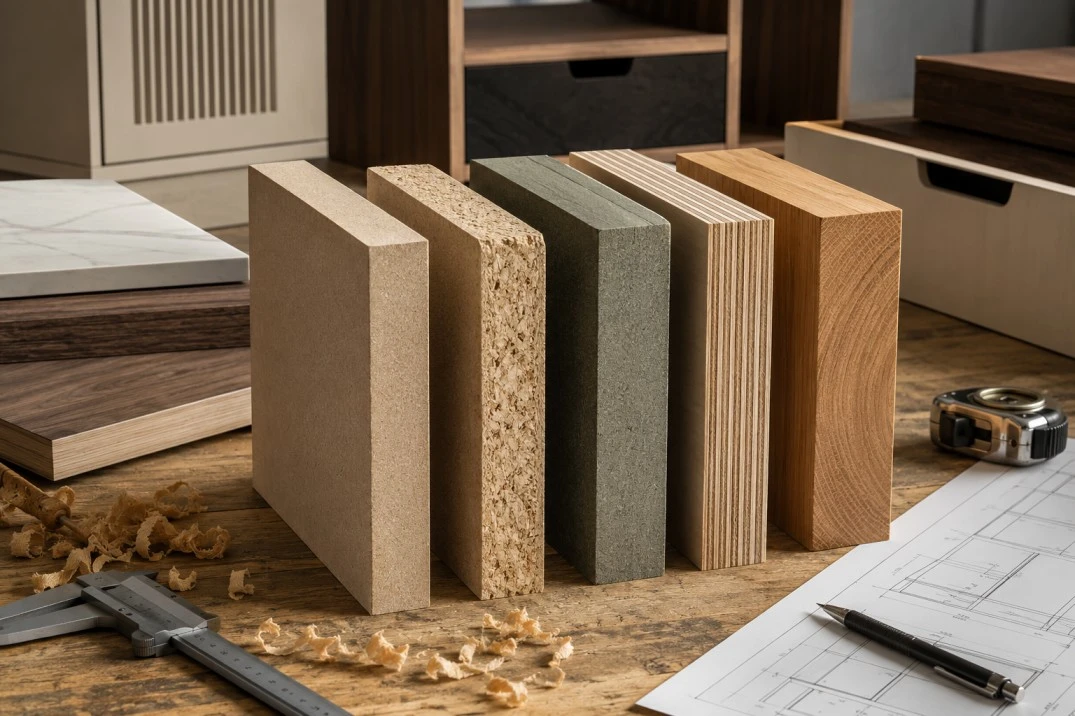
Types of Engineered Wood Used in Furniture
Before comparing MDF and particle board, it's helpful to understand the main engineered materials used in modern furniture manufacturing.
| Material | Made From | Best Used For |
| ------------------ | ----------------------------------------------------------- | ------------------------------------------------------------ |
| **MDF** | Fine wood fibres compressed under high pressure | Painted furniture, TV units, decorative panels, study tables |
| **Particle Board** | Wood chips and particles bonded with resin | Budget furniture, modular furniture, shelves |
| **HDHMR** | High-density engineered wood with moisture-resistant resins | Premium wardrobes, modular furniture, kitchens |
| **Plywood** | Multiple layers of natural wood veneer bonded together | Beds, wardrobes, kitchens, heavy-duty furniture |
| **Blockboard** | Solid wood strips sandwiched between veneers | Doors, long shelves, partitions, tables |
Although these materials may appear similar once finished with laminates or veneers, their internal construction differs significantly, affecting strength, durability, moisture resistance, and overall performance.
Why Modern Furniture Rarely Uses Solid Wood Alone
Many buyers believe that all premium furniture should be made entirely from solid wood. While solid wood has undeniable advantages, modern furniture manufacturing often combines different materials to achieve better performance, consistency, and functionality.
For example, a premium wardrobe might feature:
- A plywood carcass for structural strength.
- HDHMR shutters for moisture resistance.
- MDF decorative panels for intricate routed designs.
- Laminates or veneers for the finished appearance.
This combination allows manufacturers to balance durability, aesthetics, and cost while making efficient use of materials.
Rather than asking, "Is this furniture made from solid wood?", a better question is:
"Why was this particular material chosen for this specific application?"
Understanding that distinction helps buyers evaluate furniture more intelligently and appreciate that different materials excel in different roles.
Before We Compare Materials…
It's important to remember that the quality of a piece of furniture depends on more than just the board it is made from.
Other factors include:
- Manufacturing precision.
- Quality of edge banding.
- Hardware and fittings.
- Joinery methods.
- Surface finishes.
- Moisture protection.
- Installation quality.
- Everyday maintenance.
Even the best plywood or HDHMR board can perform poorly if manufacturing standards are low, while well-made furniture using the right engineered board can provide years of reliable service.
For this reason, the following sections compare not only the materials themselves but also where each one performs best, where it should be avoided, and how to choose the right option for your home.
What Is MDF? A Complete Guide to Medium Density Fibreboard
Medium Density Fibreboard, commonly known as MDF, is one of the most widely used engineered wood products in the modern furniture industry. From wardrobes and TV units to study tables, decorative wall panels, office furniture, and modular storage, MDF has become a preferred material because of its smooth finish, consistent quality, and excellent workability.
Despite its popularity, MDF is also one of the most misunderstood furniture materials. Some buyers assume it is weak simply because it isn't solid wood, while others believe it should never be used in premium furniture. The reality is that MDF is a purpose-built material designed for specific applications where it often performs better than natural timber.
Understanding what MDF is, how it is manufactured, and where it should be used will help you make more informed decisions when comparing furniture.
What Does MDF Stand For?
MDF stands for Medium Density Fibreboard.
It is an engineered wood panel manufactured by breaking down hardwood and softwood into extremely fine wood fibres. These fibres are mixed with synthetic resins and wax before being compressed under high temperature and high pressure into dense, uniform boards.
Unlike plywood, which consists of multiple wood veneer layers, or particle board, which uses larger wood chips, MDF has an extremely fine and homogeneous internal structure.
This fine structure gives MDF several unique characteristics:
- Smooth surface
- Uniform density
- Easy machining
- Excellent paint finish
- No visible wood grain
- Minimal natural defects
These qualities make it particularly suitable for furniture requiring clean lines and decorative detailing.
How Is MDF Manufactured?
The manufacturing process is one of the reasons MDF offers such consistent quality.
Step 1 – Wood Selection
Manufacturers begin with sustainably sourced hardwood and softwood residues, including sawmill offcuts and timber fibres. Using these resources helps reduce waste while making efficient use of available wood.
Step 2 – Fibre Preparation
The wood is cleaned and processed into fine fibres using specialised equipment. Unlike particle board, which contains larger chips, MDF uses fibres that are much smaller and more uniform.
Step 3 – Resin and Wax Application
The fibres are blended with synthetic resin binders and wax. These additives help bond the fibres together and improve dimensional stability during manufacturing.
Step 4 – High Pressure Compression
The fibre mixture is compressed under carefully controlled heat and pressure to produce dense, flat panels with a consistent internal structure.
Step 5 – Sanding and Finishing
Both surfaces are precision sanded to create an exceptionally smooth finish suitable for painting, laminating, veneering, or decorative coatings.
The result is a board with consistent density, smooth edges, and reliable machining properties.
Why Do Furniture Manufacturers Use MDF?
Modern furniture manufacturers choose MDF because it solves several challenges that natural wood cannot.
Consistent Quality
Natural wood contains knots, grain variations, and natural imperfections. MDF provides a uniform surface throughout the entire board.
Smooth Surface
Its smooth face makes it one of the best materials for:
- Painted furniture
- Decorative grooves
- CNC routing
- Fluted panel designs
- Modern wall panels
Precision Machining
Because MDF has no grain direction, it can be cut, routed, drilled, and shaped with remarkable precision.
This is why many premium TV units, decorative wardrobes, and luxury wall panels use MDF for front-facing decorative elements.
Better Paint Finish
Unlike natural timber, MDF produces an exceptionally smooth painted surface.
High-gloss finishes.
Matte finishes.
PU paint.
Duco paint.
All perform exceptionally well on quality MDF.
Types of MDF
Not all MDF is the same. Different grades are manufactured for different applications.
Standard MDF
The most common type used for indoor furniture in dry environments.
Ideal for:
- TV Units
- Study Tables
- Display Units
- Decorative Furniture
Moisture Resistant MDF (MR MDF)
Contains additives that improve resistance to humidity.
Suitable for:
- Wardrobes
- Bedroom Furniture
- Modular Storage
- Utility Areas
However, it should not be confused with waterproof materials.
Fire Retardant MDF
Designed for commercial environments where improved fire performance is required.
Often used in:
- Hotels
- Offices
- Commercial Interiors
High Density MDF (HDF)
Manufactured at a much higher density than standard MDF.
Offers:
- Greater strength
- Better durability
- Improved impact resistance
Frequently used for:
- Premium furniture
- Flooring
- Decorative panels
Advantages of MDF
One of the reasons MDF remains so popular is its combination of affordability, versatility, and finish quality.
Exceptionally Smooth Finish
Perfect for painted furniture.
Perfect for decorative wall panels.
Perfect for modern minimalist interiors.
Excellent for CNC Designs
Fluted wardrobes.
Decorative TV panels.
Wall mouldings.
Carved cabinet doors.
All are much easier to manufacture using MDF.
Stable Dimensions
Unlike natural wood, MDF does not contain grain that expands and contracts unevenly.
This provides greater consistency in controlled indoor environments.
Easy to Laminate
Manufacturers can easily apply:
- Laminates
- Veneers
- Acrylic sheets
- PU paint
- Decorative films
allowing homeowners to choose from hundreds of finishes.
Affordable Premium Appearance
MDF enables premium-looking furniture without the cost associated with solid hardwood.
Disadvantages of MDF
No furniture material is perfect, and understanding MDF's limitations is just as important as understanding its strengths.
Sensitive to Excess Moisture
Standard MDF can swell if exposed to standing water or prolonged moisture.
For humid areas, moisture-resistant grades or alternative materials may be more appropriate.
Lower Screw Holding Strength Than Plywood
Repeated removal and reinsertion of screws can weaken the board over time.
Professional installation and quality hardware help minimise this issue.
Heavier Than Many People Expect
Because of its density, MDF can be surprisingly heavy.
This should be considered when designing large doors or wall-mounted furniture.
Dust During Machining
Cutting MDF produces fine dust, making proper extraction systems and protective equipment essential during manufacturing.
This is primarily a concern for manufacturers rather than homeowners.
Where Is MDF Best Used?
MDF performs particularly well in applications where appearance, smooth finishes, and detailed machining are priorities.
Recommended uses include:
- TV Units
- Study Tables
- Decorative Wall Panels
- Painted Wardrobes
- Display Cabinets
- Bookshelves
- Entertainment Units
- Office Furniture
- Reception Desks
- Feature Wall Designs
Where Should MDF Be Avoided?
Although MDF is highly versatile, there are situations where other materials are more suitable.
Consider alternatives for:
- Outdoor furniture
- Constantly wet environments
- Heavy structural applications
- Areas with repeated water exposure
- Furniture requiring frequent dismantling and reassembly
Choosing the correct material for the environment is more important than selecting the most expensive option.
Common Myths About MDF
Myth: MDF Is Cheap and Low Quality
Reality: MDF is available in many grades. High-quality MDF is used by premium furniture manufacturers worldwide for painted finishes, decorative panels, and precision-machined components.
Myth: MDF Is Always Weaker Than Other Materials
Reality: MDF is designed for specific purposes. While plywood may outperform MDF in structural applications, MDF often provides superior surface quality and machining capabilities.
Myth: MDF Cannot Last Long
Reality: Properly manufactured and well-maintained MDF furniture used in suitable indoor environments can provide many years of reliable service.
Myth: Solid Wood Is Always Better
Reality: Different materials serve different purposes. Premium furniture often combines MDF, plywood, HDHMR, laminates, veneers, and solid wood to achieve the best balance of performance, appearance, and cost.
Excellent. This is where your article starts ranking for dozens of long-tail keywords.
We'll make this section just as comprehensive as MDF. One thing I want to do differently from other furniture websites is be fair. Most websites either unfairly criticize particle board or oversell it. We'll explain where it's genuinely useful and where it isn't.
What Is Particle Board? A Complete Guide
Particle board is one of the most widely used engineered wood products in the global furniture industry. It is commonly found in wardrobes, study tables, office furniture, modular kitchens, bookshelves, TV units, and ready-to-assemble furniture because it offers an excellent balance between affordability, consistency, and manufacturing efficiency.
Although particle board often receives criticism from buyers, much of its reputation comes from confusion between low-quality boards and furniture-grade engineered panels. In reality, particle board is manufactured in several grades, densities, and finishes, and its performance depends largely on the quality of the board, the manufacturing process, and how it is used.
When selected for the right application, particle board can provide practical, attractive, and cost-effective furniture for many years.
What Is Particle Board Made Of?
Particle board is manufactured by combining small wood chips, sawdust, wood shavings, and wood particles with synthetic resin adhesives. These materials are compressed under high pressure and temperature to create flat, uniform panels.
Unlike MDF, which is made from fine wood fibres, particle board retains larger wood particles within its core. This gives the board a different internal structure, density, and performance.
The manufacturing process helps utilise wood waste efficiently, making particle board one of the most resource-efficient engineered wood products available.
How Is Particle Board Manufactured?
The production process follows several carefully controlled stages.
Step 1 – Raw Material Collection
Manufacturers collect wood chips, sawdust, planer shavings, and recycled wood materials that meet quality standards.
Step 2 – Drying
The particles are dried to achieve a controlled moisture content, ensuring better bonding during production.
Step 3 – Resin Mixing
The dried particles are blended with specialised synthetic resins and additives. Depending on the intended application, manufacturers may also include moisture-resistant chemicals or fire-retardant additives.
Step 4 – Layer Formation
The particles are arranged in layers before pressing.
Typically:
- Fine particles form the outer surfaces.
- Larger particles create the core.
This layered structure improves surface quality while maintaining manufacturing efficiency.
Step 5 – Hot Pressing
The layered mat is compressed under high pressure and temperature, bonding the particles into a solid panel.
Step 6 – Sanding
The finished boards are precision sanded to achieve a flat surface suitable for laminates, veneers, or decorative finishes.
Types of Particle Board
Not all particle boards perform the same. Understanding the different grades helps buyers choose furniture more confidently.
Standard Particle Board
The most common option for indoor furniture used in dry conditions.
Best suited for:
- Bookshelves
- TV Units
- Study Tables
- Storage Cabinets
- Budget Furniture
Moisture Resistant Particle Board
Manufactured using moisture-resistant resins to improve performance in humid indoor environments.
Suitable for:
- Wardrobes
- Utility Areas
- Bedroom Furniture
It offers better humidity resistance than standard particle board but should not be considered waterproof.
Pre-Laminated Particle Board
One of the most widely used materials in modular furniture.
The laminate is factory-applied, resulting in:
- Uniform finish
- Faster production
- Lower maintenance
- Wide range of colours and textures
High-Density Particle Board
Manufactured with greater compression and density, improving:
- Strength
- Stability
- Surface quality
- Hardware performance
Premium furniture manufacturers often choose higher-density boards instead of low-density alternatives.
Advantages of Particle Board
Particle board remains popular because it offers several practical advantages.
Affordable
One of its biggest strengths is cost-effectiveness. It allows manufacturers to produce attractive furniture at a lower price compared to plywood or solid wood.
Smooth Surface
When finished with laminates or veneers, particle board provides an attractive appearance suitable for modern interiors.
Lightweight
Compared with MDF, particle board is generally lighter, making transportation and installation easier.
Ideal for Modular Furniture
Many modular wardrobes, office workstations, display units, and storage systems use laminated particle board because of its consistent dimensions and ease of manufacturing.
Efficient Use of Wood Resources
Particle board makes effective use of wood residues that might otherwise become waste, contributing to more efficient material utilisation.
Disadvantages of Particle Board
Understanding its limitations helps buyers decide whether it suits a particular application.
Lower Moisture Resistance
Standard particle board can swell if exposed to excessive moisture over time.
For bathrooms, kitchens, or damp environments, moisture-resistant grades or alternative materials may be more suitable.
Moderate Screw Holding Strength
Particle board performs best when hardware is installed correctly and not repeatedly removed.
Frequent disassembly may weaken screw connections over time.
Lower Structural Strength Than Plywood
Although suitable for many furniture applications, particle board is generally less suitable for heavy structural loads compared to quality plywood.
Edge Protection Is Important
Proper edge banding helps protect particle board from moisture and improves durability.
High-quality furniture manufacturers invest considerable attention in edge finishing.
Where Is Particle Board Best Used?
Particle board performs well in furniture that experiences normal indoor use without excessive moisture.
Recommended applications include:
- Wardrobes
- Study Tables
- Bookshelves
- Office Furniture
- Display Cabinets
- TV Units
- Modular Storage
- Shoe Cabinets
- Side Tables
- Reception Counters
With quality laminates and professional manufacturing, these products can offer excellent value.
Where Should Particle Board Be Avoided?
Particle board is not the ideal choice for every situation.
It is generally better to choose alternative materials for:
- Outdoor furniture
- Constantly damp areas
- Heavy industrial furniture
- High-moisture kitchens (unless using moisture-resistant grades)
- Furniture subjected to repeated dismantling
Selecting the appropriate material for the environment remains more important than choosing the cheapest option.
Common Myths About Particle Board
Myth: Particle Board Is Always Poor Quality
Reality: Furniture-grade particle board manufactured by reputable companies can perform very well in suitable indoor applications. Performance depends on density, manufacturing quality, laminates, edge sealing, and installation.
Myth: Particle Board Breaks Easily
Reality: Properly designed furniture distributes weight effectively. Problems usually occur when boards are overloaded or exposed to prolonged moisture.
Myth: Premium Furniture Never Uses Particle Board
Reality: Many international furniture brands use high-quality particle board for selected components because it offers consistent dimensions, attractive finishes, and cost efficiency.
Myth: Particle Board and MDF Are the Same
Reality: Although both are engineered wood products, MDF uses fine wood fibres, while particle board is manufactured from larger wood particles. This difference affects density, machining characteristics, finish quality, and structural performance.
MDF vs Particle Board – Which Is Better?
This is one of the most common questions homeowners ask, but there is no single winner.
Choose MDF if you need:
- Smooth painted finishes
- Decorative routed designs
- Premium wall panels
- Fluted furniture
- High-quality paint surfaces
Choose Particle Board if you need:
- Cost-effective modular furniture
- Laminated wardrobes
- Bookshelves
- Office furniture
- Budget-friendly storage solutions
The better choice depends on the furniture's purpose, the expected usage, and your budget, not simply on the material's name.
Excellent. This section is where we start differentiating your article from 99% of furniture websites.
Most websites barely mention HDHMR, even though it's becoming one of the most talked-about engineered boards in premium modular furniture. Covering it properly positions Ranchi Furniture Hub as knowledgeable and up to date.
What Is HDHMR? The Premium Alternative to MDF and Particle Board
As homeowners become more informed about furniture quality, one material has gained significant attention in recent years—HDHMR, or High Density High Moisture Resistant Board.
HDHMR is an advanced engineered wood panel designed to provide higher density, better moisture resistance, improved screw holding capacity, and greater durability than standard MDF and conventional particle board. Because of these characteristics, it has become a preferred material for premium modular furniture, wardrobes, TV units, kitchen cabinets, and other interior applications where strength and long-term performance are important.
Although HDHMR generally costs more than standard engineered boards, many furniture manufacturers consider it a worthwhile investment because it combines structural strength with a smooth, attractive finish.
What Does HDHMR Stand For?
HDHMR stands for:
High Density High Moisture Resistant Board
Each part of the name highlights one of its key characteristics.
- High Density – The board is compressed more densely than conventional MDF or particle board, resulting in a stronger and more stable structure.
- High Moisture Resistant – Special moisture-resistant resins and manufacturing processes improve the board's ability to withstand humidity and occasional moisture exposure.
It is important to understand that high moisture resistant does not mean waterproof. Continuous exposure to standing water can still damage the material, but it performs significantly better than standard MDF or particle board in humid indoor environments.
How Is HDHMR Manufactured?
HDHMR is manufactured using refined wood fibres combined with specialised resins and additives. These materials are compressed under extremely high pressure and temperature to produce dense, durable boards with a uniform internal structure.
Compared with standard MDF, the manufacturing process involves:
- Higher compression pressure
- Greater board density
- Improved resin formulation
- Enhanced moisture-resistant additives
- Better dimensional stability
The result is a panel that offers improved strength, better hardware performance, and enhanced durability for demanding furniture applications.
Why Is HDHMR Becoming So Popular?
The furniture industry has shifted towards modular designs, larger wardrobes, floating TV units, and customised storage systems. These designs place greater demands on furniture materials.
HDHMR addresses many of these challenges by offering a combination of:
- Higher structural strength
- Better screw holding capacity
- Improved moisture resistance
- Smooth surface finish
- Excellent machining properties
- Compatibility with modern laminates and veneers
Because of these qualities, HDHMR is increasingly used in premium residential interiors and customised furniture projects.
Advantages of HDHMR
Superior Moisture Resistance
One of HDHMR's biggest advantages is its ability to withstand humid conditions better than standard MDF or conventional particle board.
This makes it particularly suitable for:
- Wardrobes
- Kitchen cabinets
- Utility furniture
- Bathroom vanity units (where direct water exposure is limited)
Higher Density
The dense internal structure improves:
- Overall strength
- Dimensional stability
- Edge quality
- Durability
This allows manufacturers to produce furniture that remains stable even with larger doors and heavier hardware.
Better Screw Holding Strength
Premium wardrobes and modular furniture rely heavily on hinges, drawer runners, and lifting mechanisms.
HDHMR generally provides stronger screw retention than standard MDF, making it a preferred choice for frequently used furniture.
Smooth Surface
Like MDF, HDHMR offers an excellent surface for:
- Laminates
- Acrylic finishes
- PU paint
- Veneers
- Decorative coatings
This allows homeowners to achieve premium aesthetics without compromising structural performance.
Longer Service Life
When properly manufactured and installed, HDHMR furniture can provide excellent long-term durability in residential interiors.
Limitations of HDHMR
Although HDHMR offers many advantages, it is not the perfect material for every application.
Higher Cost
HDHMR generally costs more than standard MDF and particle board because of its specialised manufacturing process and higher density.
For some budget-focused furniture projects, the additional investment may not always be necessary.
Increased Weight
Its higher density also makes the boards heavier.
Large furniture pieces may require stronger installation methods and quality hardware to support the additional weight.
Not Completely Waterproof
While HDHMR performs well in humid environments, it should not be considered a substitute for waterproof construction materials.
Proper edge sealing and professional installation remain essential.
Best Applications for HDHMR
HDHMR performs exceptionally well in furniture that requires strength, durability, and long-term reliability.
Recommended applications include:
- Modular Wardrobes
- Bedroom Furniture
- TV Units
- Kitchen Cabinets
- Storage Cabinets
- Display Units
- Office Furniture
- Dressing Units
- Custom Furniture
- Utility Cabinets
It is particularly suitable for furniture that experiences frequent daily use.
HDHMR vs MDF
Although both materials are manufactured using wood fibres, their performance differs considerably.
FeatureHDHMRMDFDensityHigherMediumMoisture ResistanceBetterModerateScrew HoldingBetterGoodStrengthHigherModerateCostHigherLowerPainted FinishExcellentExcellentDecorative RoutingExcellentExcellentStructural ApplicationsBetterModerate
For premium wardrobes, TV units, and modular furniture, HDHMR is often the stronger long-term choice.
HDHMR vs Particle Board
Many homeowners compare these materials when choosing modular furniture.
FeatureHDHMRParticle BoardDensityHighMediumMoisture ResistanceBetterModerateStructural StrengthHigherModerateHardware PerformanceBetterModerateLifespanLongerDepends on qualityPriceHigherLower
Particle board remains a practical option for budget furniture, while HDHMR is generally preferred for premium installations where durability is a priority.
Should You Choose HDHMR?
HDHMR is an excellent option if you are:
- Furnishing your permanent home.
- Investing in premium modular furniture.
- Building custom wardrobes.
- Installing large TV units.
- Designing storage furniture for long-term use.
- Looking for improved moisture resistance compared with standard MDF.
However, if your budget is limited or the furniture is intended for lighter-duty applications, high-quality MDF or particle board may still provide excellent value.
The right choice depends on your priorities, room conditions, expected usage, and budget.
Excellent. Now we move into the materials that almost every Indian homeowner has heard of: Plywood and Solid Wood.
This section is important because many buyers automatically assume "solid wood = best" or "plywood = premium" without understanding where each material truly excels. We'll keep the discussion practical and balanced.
Understanding Plywood: Strength, Stability and Everyday Reliability
Plywood has been one of the most trusted materials in the furniture and construction industry for decades. It is widely used in wardrobes, beds, modular kitchens, TV units, storage cabinets, office furniture, and custom interiors because it offers an excellent combination of strength, durability, and dimensional stability.
Unlike MDF or particle board, plywood is manufactured by bonding multiple thin sheets of natural wood veneer together. Each layer is placed with its wood grain running in the opposite direction to the previous layer, creating a cross-laminated structure that significantly improves strength and reduces the chances of bending or warping.
Because of this unique construction, plywood remains one of the most dependable engineered wood products available for high-load furniture and structural applications.
How Is Plywood Manufactured?
Plywood begins with carefully selected timber logs.
The manufacturing process includes:
Step 1 – Veneer Production
Large logs are rotated on specialised machines to produce thin sheets of natural wood called veneers.
Step 2 – Drying
These veneers are dried to achieve the correct moisture level.
Step 3 – Layer Arrangement
The veneers are stacked so that the grain direction alternates at 90 degrees between adjacent layers.
This cross-grain construction improves:
- Structural strength
- Dimensional stability
- Crack resistance
- Load-bearing capacity
Step 4 – Bonding
The veneer layers are bonded using specialised adhesives under high pressure and heat.
The adhesive type determines whether the plywood is suitable for dry interiors, humid environments, or marine applications.
Step 5 – Finishing
The panels are trimmed, sanded, graded, and prepared for laminates, veneers, paints, or direct furniture manufacturing.
Types of Plywood
Not all plywood is identical. Choosing the right grade is essential.
Commercial Plywood (MR Grade)
Also known as Moisture Resistant Plywood.
Suitable for:
- Bedroom furniture
- Wardrobes
- Study tables
- TV units
- Display furniture
It performs well under normal indoor conditions.
BWR Plywood (Boiling Water Resistant)
Manufactured using stronger waterproof adhesives.
Suitable for:
- Kitchens
- Utility furniture
- Dining areas
- Furniture exposed to higher humidity
BWP / Marine Plywood
The highest-performing category.
Designed for environments exposed to significant moisture.
Common applications include:
- Modular kitchens
- Bathroom furniture
- Premium cabinetry
- Commercial interiors
Despite its name, marine plywood is not just for boats—it is often chosen for premium residential furniture requiring maximum durability.
Advantages of Plywood
Excellent Structural Strength
The cross-laminated construction gives plywood excellent load-bearing capacity.
This makes it ideal for:
- Beds
- Wardrobes
- Shelving
- Dining tables
- Kitchen cabinets
Better Screw Holding
Compared with many engineered boards, plywood provides excellent screw retention, making it suitable for frequently used doors, drawers, and hardware.
Good Moisture Resistance
Depending on the grade, plywood performs well in humid conditions and is often preferred for kitchens and wardrobes.
Long Service Life
Quality plywood furniture can last for many years with proper manufacturing, installation, and maintenance.
Versatile Applications
Plywood adapts well to:
- Laminates
- Veneers
- Paint finishes
- Decorative surfaces
making it suitable for both modern and traditional interiors.
Limitations of Plywood
Although plywood is highly regarded, it also has some considerations.
Higher Cost
Quality plywood generally costs more than MDF or particle board.
Surface Finish
Unlike MDF, plywood does not naturally provide an ultra-smooth painted surface.
For premium painted furniture, manufacturers often use MDF for decorative components.
Quality Variations
The quality of plywood depends on:
- Number of veneer layers
- Timber species
- Adhesive quality
- Manufacturing standards
Not all plywood sold in the market performs equally.
Best Applications for Plywood
Plywood is particularly suitable for:
- Beds
- Wardrobes
- Kitchen Cabinets
- Dining Tables
- Storage Units
- Office Furniture
- Display Cabinets
- Modular Furniture
- Bookshelves
- Custom Furniture
Understanding Solid Wood
Solid wood is the traditional furniture material that has been used for centuries.
Unlike engineered boards, solid wood is cut directly from natural timber and retains its original grain, texture, and unique characteristics.
Popular species include:
- Teak
- Oak
- Sheesham
- Walnut
- Ash
- Maple
- Pine
Every piece of solid wood is unique, with natural variations in grain and colour that cannot be perfectly replicated by manufactured boards.
Advantages of Solid Wood
Timeless Beauty
Natural grain patterns create a premium appearance that many homeowners appreciate.
Exceptional Durability
When properly maintained, quality solid wood furniture can last for decades.
Some pieces are even passed down through generations.
Repairable
Minor scratches, dents, and surface damage can often be repaired by sanding and refinishing.
Strong and Stable
Solid wood performs well in furniture designed for long-term use.
Adds Character
No two pieces of solid wood are exactly alike, giving furniture a distinctive appearance.
Limitations of Solid Wood
Although solid wood is often considered premium, it is not automatically the best choice for every application.
Expensive
Solid timber is generally the most expensive furniture material.
Natural Movement
Wood expands and contracts with changes in humidity and temperature.
Professional manufacturing accounts for this movement, but it remains a natural characteristic.
Maintenance
Solid wood requires periodic care to maintain its appearance.
Weight
Large solid wood furniture can be considerably heavier than engineered alternatives.
Limited Design Flexibility
Intricate routed designs and perfectly smooth painted finishes are often easier to achieve using MDF.
Plywood vs Solid Wood
This comparison is one of the most common questions among homeowners.
| Feature | Plywood | Solid Wood |
| ------------------- | ---------------------- | ----------------------------- |
| Price | Lower | Higher |
| Stability | Excellent | Natural movement possible |
| Moisture Resistance | Good (grade dependent) | Depends on species and finish |
| Weight | Moderate | Heavy |
| Maintenance | Low | Moderate |
| Structural Strength | Excellent | Excellent |
| Natural Grain | Veneer only | Yes |
| Lifespan | Long | Very Long |
Neither material is universally better.
Solid wood offers timeless craftsmanship and natural beauty, while plywood provides excellent structural performance, dimensional stability, and cost efficiency.
Which Material Should You Choose?
Choosing the right furniture material depends on the purpose of the furniture rather than following a single rule.
A practical guide is:
- Beds: Quality plywood or solid wood.
- Wardrobes: HDHMR or plywood for long-term durability.
- TV Units: MDF for decorative finishes, HDHMR or plywood for structural components.
- Study Tables: MDF or plywood depending on usage.
- Dining Tables: Solid wood or quality plywood with premium finishes.
- Kitchen Cabinets: BWR or Marine Plywood, or HDHMR where appropriate.
- Budget Furniture: High-quality particle board for suitable indoor applications.
The best furniture often combines multiple materials rather than relying on just one.
For example, a premium wardrobe may use a plywood carcass for strength, HDHMR shutters for moisture resistance, and MDF decorative panels for routed designs. Understanding these combinations helps you evaluate furniture based on performance rather than assumptions.
Furniture Material Comparison: MDF vs Particle Board vs HDHMR vs Plywood vs Solid Wood
Now that we've explored each material individually, let's compare them side by side. While every material has advantages, there is no single "best" option for every piece of furniture. The right choice depends on how the furniture will be used, the expected lifespan, your budget, the environment, and the type of finish you want.
The following comparisons simplify the decision-making process.
MDF vs Particle Board
This is one of the most common comparisons for modular furniture, wardrobes, study tables, and TV units.
| Feature | MDF | Particle Board |
| ------------------- | ---------------- | ------------------------ |
| Raw Material | Fine wood fibres | Wood particles and chips |
| Surface Finish | Very smooth | Smooth after lamination |
| Density | Higher | Lower |
| Weight | Heavy | Lighter |
| Screw Holding | Better | Moderate |
| Routing & Carving | Excellent | Limited |
| Paint Finish | Excellent | Not ideal |
| Laminate Finish | Excellent | Excellent |
| Moisture Resistance | Moderate | Moderate |
| Cost | Medium | Lower |
Choose MDF If:
- You want premium painted furniture.
- Decorative routed panels are important.
- You're designing fluted wall panels.
- Smooth finishes matter.
Choose Particle Board If:
- Budget is your priority.
- You're buying modular furniture with laminates.
- The furniture will be used in dry indoor spaces.
- You want good value for money.
MDF vs HDHMR
Although both materials are fibre-based engineered boards, HDHMR is designed for heavier-duty applications.
| Feature | MDF | HDHMR |
| ------------------- | -------- | --------- |
| Density | Medium | High |
| Moisture Resistance | Moderate | Excellent |
| Strength | Good | Very Good |
| Screw Holding | Good | Excellent |
| Weight | Heavy | Heavier |
| Cost | Lower | Higher |
| Wardrobes | Good | Excellent |
| Kitchens | Moderate | Excellent |
Choose HDHMR If:
- You're building a permanent home.
- You want premium modular wardrobes.
- Furniture will experience frequent daily use.
- Moisture resistance is important.
Choose MDF If:
- Decorative finishes are your priority.
- You're building feature walls.
- You're designing TV panels.
- Budget matters more than maximum durability.
MDF vs Plywood
Many homeowners compare these two materials when buying wardrobes or study furniture.
| Feature | MDF | Plywood |
| ------------------- | --------- | ----------------- |
| Surface Smoothness | Excellent | Good |
| Structural Strength | Moderate | Excellent |
| Moisture Resistance | Moderate | Good to Excellent |
| Weight | Heavy | Moderate |
| Screw Holding | Good | Excellent |
| Lifespan | Good | Excellent |
| Painted Finish | Excellent | Good |
| Cost | Lower | Higher |
Choose Plywood If:
- The furniture carries heavy loads.
- Long-term durability is the priority.
- It's for beds or kitchens.
- Frequent hardware use is expected.
Choose MDF If:
- Decorative detailing is important.
- Paint finish is required.
- The furniture isn't highly structural.
Particle Board vs Plywood
This comparison often comes down to budget versus durability.
| Feature | Particle Board | Plywood |
| ---------------------- | -------------- | --------- |
| Price | Lower | Higher |
| Strength | Moderate | Excellent |
| Moisture Resistance | Moderate | Better |
| Weight | Light | Moderate |
| Screw Holding | Moderate | Excellent |
| Lifespan | Moderate | Long |
| Structural Performance | Moderate | Excellent |
Particle board remains an excellent option for many indoor applications, but plywood generally performs better where strength and repeated daily use are required.
HDHMR vs Plywood
This is becoming one of the most important comparisons in premium interiors.
| Feature | HDHMR | Plywood |
| ------------------- | ------------------------- | --------------------------- |
| Density | High | Moderate |
| Surface Finish | Excellent | Good |
| Moisture Resistance | Excellent | Excellent (grade dependent) |
| Screw Holding | Excellent | Excellent |
| Paint Finish | Excellent | Moderate |
| Cost | Similar to Premium Grades | Similar |
| Modular Furniture | Excellent | Excellent |
| Kitchens | Excellent | Excellent |
There is no universal winner.
Many premium furniture manufacturers combine both materials depending on the furniture component.
Solid Wood vs Engineered Wood
One of the biggest misconceptions is that engineered wood automatically means lower quality.
In reality, engineered wood is a category that includes several advanced materials specifically designed to improve stability, consistency, and manufacturing precision.
Solid Wood Advantages
- Natural beauty
- Long lifespan
- Premium craftsmanship
- Can be refinished
- Timeless appearance
Engineered Wood Advantages
- Better dimensional stability
- Consistent quality
- Wider design flexibility
- Better use of natural resources
- Modern finishes
- Lower maintenance
Many premium furniture collections combine solid wood with engineered materials to achieve the best balance between appearance, durability, and functionality.
Complete Furniture Material Comparison Table
| Feature | MDF | Particle Board | HDHMR | Plywood | Solid Wood |
| --------------------- | ------------ | -------------- | ------------ | ------------ | ---------- |
| Strength | ⭐⭐⭐ | ⭐⭐ | ⭐⭐⭐⭐ | ⭐⭐⭐⭐⭐ | ⭐⭐⭐⭐⭐ |
| Moisture Resistance | ⭐⭐⭐ | ⭐⭐ | ⭐⭐⭐⭐⭐ | ⭐⭐⭐⭐ | ⭐⭐⭐ |
| Durability | ⭐⭐⭐ | ⭐⭐⭐ | ⭐⭐⭐⭐⭐ | ⭐⭐⭐⭐⭐ | ⭐⭐⭐⭐⭐ |
| Weight | Heavy | Light | Heavy | Moderate | Heavy |
| Screw Holding | ⭐⭐⭐ | ⭐⭐ | ⭐⭐⭐⭐⭐ | ⭐⭐⭐⭐⭐ | ⭐⭐⭐⭐⭐ |
| Paint Finish | ⭐⭐⭐⭐⭐ | ⭐⭐ | ⭐⭐⭐⭐⭐ | ⭐⭐⭐ | ⭐⭐⭐ |
| Laminate Finish | ⭐⭐⭐⭐⭐ | ⭐⭐⭐⭐⭐ | ⭐⭐⭐⭐⭐ | ⭐⭐⭐⭐ | ⭐⭐⭐ |
| Decorative Routing | ⭐⭐⭐⭐⭐ | ⭐ | ⭐⭐⭐⭐⭐ | ⭐⭐ | ⭐⭐⭐ |
| Cost | Medium | Low | High | High | Premium |
| Maintenance | Low | Low | Low | Low | Medium |
| Best for Wardrobes | Good | Good | Excellent | Excellent | Good |
| Best for Beds | Moderate | Moderate | Good | Excellent | Excellent |
| Best for TV Units | Excellent | Good | Excellent | Excellent | Good |
| Best for Study Tables | Excellent | Good | Excellent | Excellent | Good |
| Best for Kitchens | Moderate | Moderate | Excellent | Excellent | Moderate |
| Lifespan* | 10–15+ years | 8–15+ years | 15–20+ years | 20–30+ years | 30+ years |
*These are general ranges. Actual lifespan depends on manufacturing quality, board grade, hardware, installation, maintenance, and environmental conditions.
Which Furniture Material Should You Choose?
If you're still unsure, here's a practical recommendation:
Choose MDF if you want:
- Premium painted furniture
- Decorative wall panels
- Fluted designs
- Modern TV units
- Stylish study tables
Choose Particle Board if you want:
- Affordable modular furniture
- Budget wardrobes
- Office furniture
- Bookshelves
- Storage cabinets
Choose HDHMR if you want:
- Premium wardrobes
- Long-lasting modular furniture
- Better moisture resistance
- High-quality custom furniture
Choose Plywood if you want:
- Strong beds
- Kitchen cabinets
- Heavy-duty furniture
- Long-term structural durability
Choose Solid Wood if you want:
- Luxury furniture
- Natural wood grain
- Timeless craftsmanship
- Furniture designed to last for decades
Perfect. This section is written specifically to target Google's "People Also Ask", AI Overviews, and LLM citations. It addresses common misconceptions directly while reinforcing the nuanced guidance you've built throughout the article.
Common Myths About Furniture Materials: Separating Fact from Fiction
The furniture industry is full of advice that's repeated so often it becomes accepted as fact. While some of these ideas contain a small amount of truth, many are oversimplified and can lead homeowners to make poor purchasing decisions.
Rather than relying on marketing claims or hearsay, it's important to understand how different furniture materials actually perform in real-world applications. The following myths are among the most common misconceptions buyers encounter when shopping for furniture.
Myth 1: Solid Wood Is Always the Best Choice
Reality: Solid wood is an excellent material, but it is not automatically the best choice for every piece of furniture.
Solid wood offers timeless beauty, excellent durability, and a premium appearance. However, it is also more expensive, heavier, and naturally expands and contracts with changes in humidity. These characteristics make it ideal for certain applications but less practical for others.
Modern furniture often combines multiple materials to achieve better performance. For example, a wardrobe may use plywood for the structural frame, HDHMR for doors exposed to humidity, and MDF for decorative routed panels. This combination can deliver greater stability, design flexibility, and cost efficiency than using solid wood alone.
The best material is the one that suits the furniture's purpose, environment, and expected lifespan—not simply the most expensive option.
Myth 2: MDF Is Weak and Low Quality
Reality: High-quality MDF is used by premium furniture manufacturers around the world.
MDF is engineered to provide a smooth, uniform surface that is ideal for painted finishes, decorative grooves, CNC routing, and modern furniture designs. It performs exceptionally well in indoor environments where moisture exposure is controlled.
Its limitations are primarily related to prolonged water exposure and lower screw holding compared to plywood. Within its intended applications, MDF is a reliable and widely respected material.
Myth 3: Particle Board Should Never Be Used
Reality: Particle board has an important place in modern furniture manufacturing.
The negative reputation of particle board often comes from low-quality products that use poor manufacturing techniques or inadequate edge protection. Furniture-grade particle board produced by reputable manufacturers can provide years of reliable service when used in appropriate indoor environments.
It remains a practical choice for modular wardrobes, bookshelves, office furniture, storage units, and other applications where extreme structural strength is not required.
The key is choosing quality boards and ensuring proper manufacturing, edge sealing, and installation.
H2
Myth 4: Engineered Wood Is Fake Wood
Reality: Engineered wood is made from real wood.
Products such as MDF, HDHMR, plywood, and particle board are manufactured using real wood fibres, wood veneers, or wood particles combined with advanced adhesives and manufacturing processes.
The term "engineered" refers to how the material is produced—not whether it contains wood.
Many premium furniture brands use engineered wood because it offers consistent quality, dimensional stability, and efficient use of natural resources.
Myth 5: Plywood Is Completely Waterproof
Reality: Plywood grades vary significantly.
Commercial plywood, BWR plywood, and marine plywood are manufactured for different environments.
While marine-grade plywood provides excellent resistance to moisture, no plywood should be expected to remain unaffected by prolonged standing water or poor installation.
Proper sealing, edge protection, and maintenance remain important regardless of the plywood grade.
Myth 6: Heavier Furniture Means Better Quality
Reality: Weight alone does not determine quality.
Some engineered materials, such as MDF, are naturally dense and heavy, while certain solid wood species are comparatively lighter.
Furniture quality depends on factors such as:
- Material selection
- Board grade
- Manufacturing precision
- Joinery
- Hardware quality
- Surface finish
- Installation
A heavier wardrobe is not necessarily stronger or longer lasting than a lighter one made from a better-suited material.
Myth 7: Expensive Furniture Always Lasts Longer
Reality: Price and durability are not always directly related.
Premium furniture often includes better materials, hardware, and craftsmanship, but price can also reflect branding, design, or imported finishes.
When comparing furniture, focus on:
- Material specifications
- Construction quality
- Hardware brands
- Edge banding
- Warranty
- Manufacturer reputation
Understanding what you're paying for is more important than comparing price alone.
Myth 8: One Material Should Be Used Throughout the Entire Piece of Furniture
Reality: The best furniture often combines different materials.
For example:
- Plywood for the internal structure
- HDHMR for moisture-prone components
- MDF for decorative panels
- Solid wood for exposed legs or frames
- Laminates or veneers for the finished surface
Each material is selected because it performs best in that particular role.
This approach balances strength, aesthetics, durability, and cost.
Myth 9: Imported Furniture Is Always Better Than Indian Furniture
Reality: Quality depends on manufacturing standards, not the country of origin.
Many Indian manufacturers produce furniture that meets international standards using high-quality plywood, HDHMR, MDF, premium laminates, and branded hardware.
Similarly, imported furniture can vary from entry-level flat-pack products to luxury handcrafted collections.
Rather than focusing on origin, evaluate:
- Material quality
- Hardware
- Manufacturing process
- Warranty
- Service support
- After-sales assistance
Myth 10: Furniture Material Alone Determines Durability
Reality: Material is only one part of the equation.
The lifespan of furniture also depends on:
- Board thickness
- Edge banding quality
- Joinery
- Hardware systems
- Installation accuracy
- Everyday usage
- Maintenance
- Indoor environment
Even the highest-grade plywood or solid wood can underperform if assembled poorly, while quality engineered materials can provide years of dependable service when properly designed and installed.
The Smart Way to Choose Furniture Materials
Instead of asking:
"Which material is the best?"
Ask these questions instead:
- Where will the furniture be used?
- Will it be exposed to moisture?
- How much weight will it carry?
- How often will it be used?
- What finish do I want?
- What is my budget?
- Am I buying temporary furniture or furnishing my long-term home?
These questions lead to better decisions than simply choosing the material with the strongest reputation.
Excellent. This is the commercial section of the article.
If Part 8 answered myths, Part 9 answers the question every buyer eventually asks:
"Okay... so what should I actually buy?"
This section will naturally link to almost every category page on your website.
Furniture Material Buying Guide: Which Material Is Best for Every Type of Furniture?
After understanding the strengths and limitations of MDF, particle board, HDHMR, plywood, and solid wood, the next step is choosing the right material for the furniture you plan to buy.
There is no universal "best" material. A wardrobe has different structural requirements than a study table, while a kitchen cabinet faces very different conditions compared to a TV unit or coffee table.
Professional furniture manufacturers select materials based on the furniture's purpose, expected lifespan, moisture exposure, design requirements, and budget. Understanding these differences helps homeowners make smarter purchasing decisions and avoid paying for features they may not actually need.
The recommendations below are intended as practical guidance for modern Indian homes.
Best Material for Beds
The bed is one of the most heavily used pieces of furniture in any home. It supports significant weight every day and must remain stable for years.
Recommended Materials
🥇 Plywood
🥈 Solid Wood
🥉 HDHMR (for selected designs)
Why?
A bed frame experiences continuous structural stress. Quality plywood offers excellent strength, dimensional stability, and screw-holding performance, making it one of the most reliable choices for modern beds.
Solid wood remains an outstanding option for premium handcrafted furniture, while HDHMR may be used in decorative components or storage sections depending on the design.
Recommended for
- King Size Beds
- Queen Size Beds
- Hydraulic Storage Beds
- Platform Beds
- Custom Beds
Explore our Beds Collection to compare modern bed designs, storage options, and premium finishes for every bedroom.
Best Material for Wardrobes
Wardrobes are opened and closed thousands of times during their lifetime. They also carry substantial weight through shelves, hanging rods, drawers, and accessories.
Recommended Materials
🥇 HDHMR
🥈 Plywood
🥉 MDF (decorative shutters)
Why?
Premium wardrobes require excellent screw-holding capacity for hinges, dimensional stability for large doors, and resistance to everyday humidity. HDHMR and quality plywood perform exceptionally well in these conditions.
MDF is frequently used for decorative routed shutters or painted wardrobe doors where aesthetics are the priority.
Recommended for
- Sliding Wardrobes
- Hinged Wardrobes
- Walk-in Wardrobes
- Floor-to-Ceiling Wardrobes
- Custom Storage Systems
Explore our Wardrobes Collection for modular and custom wardrobe solutions designed for modern homes.
Best Material for TV Units
Modern TV units combine storage, cable management, display shelves, and decorative finishes.
Recommended Materials
🥇 MDF
🥈 HDHMR
🥉 Plywood
Why?
MDF is ideal for decorative wall panels, fluted designs, painted finishes, and modern entertainment units. HDHMR and plywood are often used for structural sections requiring greater strength.
Many premium TV units combine all three materials to achieve both durability and refined aesthetics.
Explore our TV Units Collection featuring contemporary wall-mounted and floor-standing entertainment units.
Best Material for Study Tables
Study tables require a smooth working surface, dimensional stability, and sufficient strength for daily use.
Recommended Materials
🥇 MDF
🥈 Plywood
🥉 HDHMR
Why?
MDF provides a smooth finish that's excellent for writing, studying, and modern desk designs. Plywood offers greater structural strength for larger workstations, while HDHMR is ideal for premium custom office furniture.
Browse our Study Tables Collection for home offices, students, and work-from-home setups.
Best Material for Dining Tables
Dining tables experience regular daily use, hot dishes, spills, and constant cleaning.
Recommended Materials
🥇 Solid Wood
🥈 Plywood
🥉 Engineered Wood with Premium Finishes
Why?
Solid wood offers timeless beauty and excellent durability, while plywood provides outstanding structural stability for modern dining furniture. Surface finish and craftsmanship are equally important in determining long-term performance.
Discover our Dining Tables Collection designed for everyday family dining and entertaining guests.
Best Material for Coffee Tables
Coffee tables combine functionality with visual appeal.
Recommended Materials
🥇 MDF
🥈 Plywood
🥉 Solid Wood
Coffee tables often incorporate decorative finishes, curved edges, fluted details, or modern minimalist designs that benefit from MDF's machining capabilities. Premium plywood and solid wood remain excellent alternatives for heavier or luxury furniture.
Explore our Coffee Tables Collection to complete your living room.
Best Material for Shoe Racks
Shoe racks are frequently placed near entrances where dust and humidity are more common.
Recommended Materials
🥇 HDHMR
🥈 Plywood
🥉 Particle Board (for budget furniture)
Why?
HDHMR's improved moisture resistance makes it well suited for entryway furniture. Quality plywood also performs well, while particle board remains a cost-effective option for indoor shoe storage when properly finished.
View our Shoe Racks Collection for stylish and practical entryway storage solutions.
Best Material for Kitchen Cabinets
Kitchens are among the most demanding environments in any home due to heat, humidity, and frequent cleaning.
Recommended Materials
🥇 Marine Plywood (BWP Grade)
🥈 HDHMR
🥉 BWR Plywood
Why?
Kitchen cabinets require materials capable of handling moisture while maintaining structural integrity. Marine plywood and HDHMR are widely used in premium modular kitchens because they provide strength, stability, and improved moisture resistance.
Best Material for Custom Furniture
Custom furniture allows manufacturers to select materials based on each project's unique requirements rather than relying on a single board throughout the design.
A premium custom furniture project may include:
- Plywood for structural components.
- HDHMR for wardrobe shutters.
- MDF for decorative routed panels.
- Solid wood for exposed frames or legs.
- Laminates, veneers, or acrylic finishes depending on the design.
Combining materials in this way creates furniture that balances durability, aesthetics, functionality, and cost.
Learn more about our Custom Furniture Solutions tailored to your home, lifestyle, and interior design preferences.
Furniture Material Recommendations by Budget
Every homeowner has different priorities. Instead of asking which material is universally best, it's often more useful to compare materials based on your investment level.
| Budget | Recommended Materials | Best For |
| ------------------- | -------------------------------------------- | -------------------------------------------------------- |
| **Budget-Friendly** | Particle Board, Standard MDF | Rental homes, temporary furniture, student accommodation |
| **Mid-Range** | Premium MDF, Commercial Plywood, BWR Plywood | Apartments, family homes, everyday furniture |
| **Premium** | HDHMR, Marine Plywood, Solid Wood | Permanent homes, luxury interiors, custom furniture |
A higher budget doesn't always mean every piece should use the most expensive material. Choosing the right material for each application often delivers better long-term value than selecting a single material throughout the home.
Quick Recommendations
If you're furnishing a modern home, this simple guide can help.
| Furniture | Best Material |
| ---------------- | ------------------------ |
| Bed | Plywood |
| Wardrobe | HDHMR / Plywood |
| TV Unit | MDF + HDHMR |
| Study Table | MDF |
| Dining Table | Solid Wood / Plywood |
| Coffee Table | MDF / Plywood |
| Shoe Rack | HDHMR |
| Kitchen Cabinets | Marine Plywood / HDHMR |
| Custom Furniture | Combination of Materials |
Frequently Asked Questions (FAQs)
1. Which furniture material lasts the longest?
Solid wood and high-quality plywood generally offer the longest lifespan when properly maintained. However, HDHMR, MDF, and particle board can also provide many years of reliable performance when used in suitable indoor environments and manufactured to high standards.
2. Which material is best for wardrobes?
HDHMR and quality plywood are widely considered the best choices for wardrobes because they provide excellent strength, screw-holding capacity, and long-term durability. MDF is often used for decorative wardrobe shutters.
3. Is MDF better than particle board?
Neither material is universally better. MDF offers smoother surfaces and better machining, while particle board is lighter and more affordable. The right choice depends on the furniture's purpose and your budget.
4. Is HDHMR better than MDF?
HDHMR generally offers higher density, better moisture resistance, and stronger screw holding than standard MDF. It is often preferred for premium wardrobes, modular furniture, and cabinetry.
5. Which material is best for beds?
Quality plywood and solid wood are the most suitable materials for bed frames because they provide excellent structural strength and long-term stability.
6. Which material is best for TV units?
Modern TV units often combine MDF for decorative finishes with HDHMR or plywood for structural components, providing both durability and premium aesthetics.
7. Is particle board good for furniture?
Yes. Furniture-grade particle board is suitable for many indoor applications such as wardrobes, bookshelves, office furniture, and modular storage when manufactured and installed properly.
8. Can MDF furniture last for many years?
Yes. High-quality MDF furniture used in dry indoor environments can provide many years of reliable service with proper care and maintenance.
9. Is plywood waterproof?
Not all plywood is waterproof. Commercial plywood, BWR plywood, and marine plywood offer different levels of moisture resistance. Choosing the correct grade is important for the intended application.
10. Is HDHMR waterproof?
No. HDHMR is highly moisture resistant but not completely waterproof. It performs significantly better than standard MDF or particle board in humid environments.
11. Which material is best for modular furniture?
HDHMR, plywood, MDF, and particle board are all commonly used in modular furniture. The ideal choice depends on the furniture's design, budget, and expected usage.
12. Which furniture material is most affordable?
Particle board is generally the most economical option, followed by MDF. HDHMR, plywood, and solid wood are typically positioned at higher price points.
13. Which material offers the smoothest painted finish?
MDF provides one of the smoothest surfaces for painted finishes, making it ideal for contemporary furniture and decorative panels.
14. Which material is best for kitchens?
Marine plywood, BWR plywood, and HDHMR are widely recommended for kitchen cabinetry because of their improved moisture resistance.
15. Which furniture material requires the least maintenance?
Laminated MDF, HDHMR, and particle board generally require minimal maintenance. Solid wood may require periodic polishing or refinishing depending on the finish.
16. Does expensive furniture always mean better quality?
Not necessarily. Quality depends on material selection, craftsmanship, hardware, manufacturing standards, and installation—not price alone.
17. What is engineered wood?
Engineered wood is a category of manufactured wood products that includes MDF, particle board, plywood, HDHMR, and blockboard. These materials are designed for specific applications and use real wood in different forms.
18. Which material is best for study tables?
MDF is ideal for smooth work surfaces and modern designs, while plywood is preferred for larger desks requiring greater structural strength.
19. Which furniture material is termite resistant?
No wood-based material is completely termite-proof by nature. Many boards are treated during manufacturing, but proper installation, regular maintenance, and professional pest control are important for long-term protection.
20. Can engineered wood be used for luxury furniture?
Absolutely. Many premium furniture manufacturers combine engineered wood with veneers, laminates, premium hardware, and solid wood components to produce high-end furniture.
21. Which material is best for custom furniture?
Custom furniture often uses a combination of plywood, HDHMR, MDF, laminates, veneers, and solid wood depending on the design, budget, and intended use.
22. Does heavier furniture mean stronger furniture?
No. Weight alone is not an indicator of quality. Construction methods, board quality, hardware, and manufacturing precision are more important.
23. Can MDF be repaired if damaged?
Minor surface scratches or chipped paint can often be repaired. However, severe water damage or structural failure usually requires replacing the affected panel.
24. Is solid wood worth the extra cost?
For homeowners seeking natural beauty, longevity, and traditional craftsmanship, solid wood can be an excellent investment. However, it is not necessary for every furniture application.
25. Which material should I choose for my home?
Choose furniture materials based on where the furniture will be used, expected daily use, moisture exposure, desired finish, and your budget. There is no single material that is ideal for every room or every type of furniture.
H2
Final Thoughts
Choosing the right furniture material is about making informed decisions rather than following common myths or marketing claims. MDF, particle board, HDHMR, plywood, and solid wood all have important roles in modern furniture manufacturing, and each performs best in specific situations.
Instead of asking which material is universally superior, consider how the furniture will be used, the environment it will be be placed in, the finish you prefer, and how long you expect it to last. A well-designed piece of furniture made from the right material will often provide better long-term value than simply choosing the most expensive option.
Modern furniture increasingly combines multiple materials to achieve the ideal balance of strength, durability, appearance, and cost. Understanding these combinations helps homeowners compare products more confidently and invest in furniture that truly suits their lifestyle.
Whether you're furnishing a new home, renovating an existing space, or planning custom interiors, taking the time to understand furniture materials is one of the smartest investments you can make before purchasing.
Ready to Choose the Right Furniture?
At Ranchi Furniture Hub, we believe informed customers make better furniture decisions. Whether you're looking for a durable bed, a premium wardrobe, a stylish TV unit, or completely custom furniture designed around your home, our team can help you select materials that match your space, lifestyle, and budget.
Explore our furniture collections or contact us for personalised guidance on choosing furniture built to last.